What the Public Record Shows About Heat at Golden Springs Elementary

Updated: Sep 17
A documented look at the gymnasium, the district response and the questions that still require independent review.
Children should be able to attend physical education without their families wondering whether the room itself is working against them.
That concern became public on August 27, when ABC 33/40 reported that the Golden Springs Elementary gymnasium did not have air conditioning. A parent described repeated school departures after her child experienced heat-related symptoms.
Superintendent Dr. D. Ray Hill acknowledged that the physical education teacher had experienced an exhaustion-related issue, said children were being moved to the library or cafeteria when necessary, and said fans had been purchased. He also said conventional heating and air conditioning for a gym would be expensive and was not then in the budget.
That news report raised a reasonable public question. What happened after district leaders knew the heat was affecting people inside the building?

Background
On September 11, 2026, at exactly 7:03 a.m. CT, a 49-page confidential investigative report was submitted to Alabama State Superintendent of Education Dr. Eric Mackey, requesting review by the appropriate state authority.
Alabama law authorizes the State Superintendent to decide controversies and disputes involving the proper administration of Alabama’s public-school system. Ala. Code § 16-4-4.
Ala. Code § 16-4-8 further authorizes the State Superintendent, under applicable State Board of Education rules, to review actions and orders of city boards of education and city superintendents involving financial matters and other matters “seriously affecting the educational interest.”
Also on September 11, 2026, at exactly 7:13 a.m. CT, the Anniston City Board of Education was separately provided with public executive-summary materials and a request for appropriate review and preservation of potentially relevant records.
Alabama law grants city boards of education the powers necessary or proper for the administration and management of their public schools. Ala. Code § 16-11-9.
As of September 17, 2026, at 10:31 p.m. CT, no response had been received by email or telephone from either/any office or any designated representative.
What this article covers
This article describes what the community driven/provided record supports, what the district did in response, what remains unresolved and what records could answer the outstanding questions.
The distinctions matter. The public should have the facts. The people involved should also have the fairness of accurate labels and appropriate limits.
The concern did not begin with the television report:
The earliest documented facility warning in the public report is a September 2, 2025 school-level communication. It described a gym fan problem and the room as very hot by late morning. That establishes awareness at the school level. It does not establish that the superintendent knew about the issue in 2025.
The 2026 record became more serious. The privacy-reviewed report says the protected evidence file contains records of heat-related health effects associated with conditions at the facility, including emergency medical evaluation or treatment. The public edition intentionally withholds the person’s role, identifying details, medical images and unnecessary dates. A later follow-up reported that medical documentation exists for another heat-related episode, but the report’s author had not reviewed that underlying medical record as of September 10. That later diagnosis is therefore described as source-reported, not independently verified.
Direct senior-level notice is documented by August 15, 2026. According to the public factual report, a written employee-association communication informed the superintendent of excessive-heat concerns involving staff and students. It requested immediate and long-term mitigation, including dedicated hydration and cooling support.
A family complaint followed later in August. School administration then committed in writing to climate-controlled alternate physical education. The record indicates that children were relocated at least sometimes, but it also raises questions about whether the alternate arrangement was consistently implemented.
That distinction is important. The evidence does not support saying the district did nothing. It supports asking whether the actions taken were timely, technically adequate, consistently followed and objectively measured.
What the recorded measurements show
The public factual report contains the following readings from a fixed-position temperature and humidity monitor that a firsthand source said remained in the same gym location during the school week:
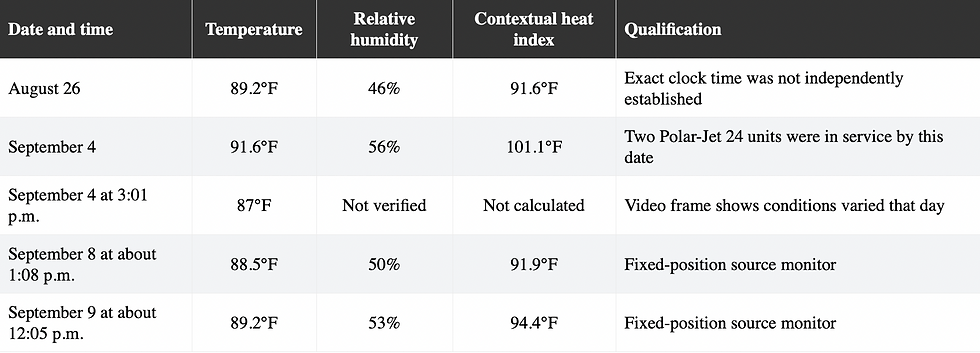
These are significant point-in-time readings, but they are not a calibrated whole-room average. The available material does not include a full-day series, a verified reset interval for the monitor’s stored high and low memory, or a professional occupied-zone environmental survey.
The heat-index figures add context because temperature alone does not describe how humidity affects the body’s ability to cool itself. The National Weather Service explains that heat index reflects how temperature feels when relative humidity is considered. But heat index is not the same as Wet Bulb Globe Temperature, commonly called WBGT. It does not measure every indoor factor, including radiant heat and physical workload.

The American Academy of Pediatrics explains that heat illness can affect active children and that humidity makes sweat less effective at cooling the body. CDC heat guidance also cautions that fans should be used only when indoor temperatures are below 90°F because, above that point, fans can increase body temperature.
Those sources provide public-health context. They do not create a school-specific legal indoor temperature limit in Alabama, and the readings alone do not establish a regulatory violation. They do explain why repeated measurements near or above 90°F during physical activity deserved a clear operating response and qualified evaluation.
What the district did
The public record includes several responsive actions:
Administrators communicated with families and staff.
Climate-controlled alternate physical education was promised.
Students were moved at least sometimes.
Maintenance activity occurred.
Existing upper wall fans were directed to remain on.
Two large Polar Blades Polar-Jet 24 portable evaporative coolers were placed in service by September 4.
The superintendent responded publicly and privately.
Those facts belong in any fair account. So does the later September 4 video frame showing 87°F, which confirms that conditions changed during the day.
The remaining issue is not whether somebody took an action. It is whether the response operated as a complete safety system. The records reviewed did not demonstrate a comprehensive district-issued indoor heat protocol identifying a monitoring schedule, an indoor trigger, a mandatory relocation point, a designated alternate-space procedure and the person authorized to make the decision.
The August 15 notice also requested dedicated hydration and cooling support at the gym. The public report says a protected firsthand account later reported that the requested dedicated station was still not present on September 8 and 9. That is narrower than saying the school had no drinking water. Procurement, delivery and photographic records could resolve the point quickly.
What did completed mean?

The public factual report preserves a September 4 district representation that the cooling work had been completed. The Golden Springs school website continues to list an Air Conditioning Cooling Project item dated September 4. That same day, after the portable intervention was in service, the fixed-position monitor displayed 91.6°F and 56% relative humidity at one documented moment. The project statement and the measurement can both be true. The word “completed” may have referred to delivery or installation rather than achieved room performance.
That is why the precise wording matters.
The current evidence does not establish that anyone intended to mislead the public. It does establish a factual tension that should be reconciled with records: What was the approved scope? What condition counted as completion? Who approved the public wording? Was any environmental performance data reviewed first? Did the project closeout refer only to installing portable units, or did it represent that the gym’s cooling problem had been resolved?
Project records, procurement documents, work orders, drafts, approvals and acceptance criteria could answer those questions without guesswork.
Portable evaporative cooling is not conventional air conditioning

The two portable units are Polar Blades Polar-Jet 24 direct evaporative coolers. They are substantial machines, and the manufacturer lists gyms among their possible uses. They are not refrigerant-based air conditioners.
The Polar-Jet operating guide explains that the units draw warm air through water-saturated media. Evaporation cools the outgoing air while adding moisture. The guide calls for access to outside fresh air and operation in an open, well-ventilated area with a continuous fresh-air supply.
Written maintenance instructions directed the gym’s upper wall fans to remain on. What the public record does not establish is whether those fans provided the needed airflow direction and volume, whether the gym had an adequate makeup-air path under normal secure-school conditions, or how the two coolers performed when the space was occupied.
There is a testable engineering question. If an evaporative system adds moisture faster than a building exhausts it, humidity may rise, cooling performance may decline and sweat may evaporate less efficiently. The existing snapshots do not prove that happened at Golden Springs. They justify measuring it.
A qualified assessment should record indoor and outdoor temperature and humidity over time, evaluate WBGT where appropriate, measure the cooler intake and discharge conditions, test the wall fans’ direction and airflow, identify the makeup-air path, and observe the system under the same door, window, security and occupancy conditions used during the school day.
That is how an equipment question becomes an answer. Fans are visible. Airflow is measurable.
A separate question about measurement method
The public report also identifies a measurement-method issue from September 9. A protected firsthand account describes a non-clinical district staff member using a red gun-style handheld instrument during a facility check and later for a human temperature check. The displayed human value was incompatible with the normal physiological temperature of an alert person.
That account does not prove manipulation, bad faith or even that the instrument malfunctioned. Infrared devices often measure the temperature of a surface within a target area. Their readings can depend on the target, distance, angle, surface characteristics and device settings. Fluke’s technical explanation describes those basic limitations.
The responsible question is straightforward: What device was used, what was measured, from what distance and mode, and how were the resulting values interpreted or recorded? The actual device, original photographs, operator instructions and any written facility-check record should settle the matter.
Six approved HVAC actions and an unresolved room level trail
The approved Anniston City ARP ESSER application lists six HVAC actions for Golden Springs Elementary: four replacements and two new units.
That fact does not prove those units were intended for the gym. The public application does not identify the rooms served, and an approved plan may later be lawfully amended. It would therefore be unfair to call the record proof that money or equipment was misused.
It is equally unreasonable to treat the entry as meaningless. The public should be able to trace each of the six actions from approval to final disposition.
For each action, the district can identify the room or area served, equipment purchased, installation date, cost, vendor, funding source, project amendment and current status. That room-level asset trail would show what the federal plan accomplished and why the gym remained without conventional air conditioning in August and September 2026.
The question is not “Where did all the money go?” as though every education-relief dollar formed one HVAC account. The question is narrower and answerable: What happened to the four replacements and two new units specifically listed for Golden Springs?
The questions that should now be answered
The cumulative record supports a focused independent review. In plain language, that review should answer:
If Golden Springs had four HVAC replacements and two new units approved through the federal plan, where was each one installed, what did each cost and were any of the projects amended?
After written notice reached the superintendent on August 15, what actions followed, on what dates and under whose direction?
What written indoor heat rule governed physical education, including monitoring, hydration, relocation and emergency response?
Was the Polar-Jet setup supported by ventilation analysis, and how did it actually perform under occupied school-day conditions?
What did the September 4 word “completed” mean, what criteria supported it and who approved the public statement?
What instrument and method produced the district’s September 9 values, and how were those readings used?
What did the Board know, when did it know it and are there additional records that materially change the analysis?
There is no need to decide the answer before doing the work. Preserve the records. Obtain the missing documents. Interview witnesses separately. Commission qualified occupied-zone heat and ventilation testing. Reconcile the public statements, measurements and federal project trail. Then issue written findings.
Why independent review is still the fair next step
This should not be reduced to a contest between people who trust the district and people who do not. Public confidence should not depend on which side tells the better story. It should rest on records and measurements that can be checked.
If a qualified review shows that the response was appropriate, consistently implemented and accurately described, the public record should say so. If it identifies material failures, the responsible authority should correct them and explain what changed.
The evidence is developed enough to require answers and incomplete enough to make a predetermined verdict irresponsible. Both things can be true.
Children, families and employees should not have to choose between silence and speculation. They deserve a permanent plan, objective monitoring and a written explanation of what happened. That is not a demand for punishment. It is a request for accountable fact-finding.
This article is published in an individual capacity. It summarizes three privacy-reviewed public documents with a final record date of September 10, 2026. Protected identities and medical details remain withheld. The article presents evidence and questions for independent review; it is not a legal finding. Anniston City Schools and anyone whose actions are discussed may provide records, corrections or material context for inclusion in the public record.
Linked public sources


Comments